
On November 1, University of San Diego Law Professor, Steven Smith, delivered a compelling lecture as part of the Rice-Hasson Distinguished Lecture Series to honor the legacy of Professor Charles E. Rice, as well as Kevin J. “Seamus” Hasson and his wife, Mary Rice Hasson. This event brought together students and faculty to engage in a vital discussion about the nature of truth.
Sponsored by the Law School’s Program on Church, State & Society, the Rice-Hasson Distinguished Lecture Series was established in 2020 to celebrate the contributions of Charles Rice, a former Notre Dame Law professor, and the Hasson family, who have deep ties to the university. In remarks before the lecture, Dean G. Marcus Cole spoke on Rice’s influence on the law school and his belief that Catholicism should shape one’s legal practice. Cole remarked that “Charlie Rice was emphatic that my Catholicism should inform every single thing I do.” As the daughter of Charles Rice, Mary Rice Hasson, who chairs the Becket Fund for Religious Liberty, shared her father’s commitment to the fundamental role of religious liberty in American life.

University of San Diego Law Professor Steven Smith
Richard Garnett, the Paul J. Schierl Fort Howard Corporation Professor of Law and faculty director of the Program on Church, State & Society, introduced Steven Smith, saying there are “few people who have had more of an impact on my idea of law than Steven Smith.” Smith’s academic work covers a wide range of legal topics, from constitutional law and federal courts to the sensitive intersection of law and religion, particularly in the areas of religious freedom and the separation of church and state.
In his lecture titled “We Hold… What Truths?” Smith confronted the challenges posed by America’s pluralistic society. He began by reflecting on the founding principles of the nation, emphasizing the need for a collective acknowledgment of truths that transcend individual perspectives.
According to Smith, recognizing divine sovereignty and the inherent dignity of human beings is essential for fostering respectful community discourse. He explained “many of us today struggle to see what situation we are in.”
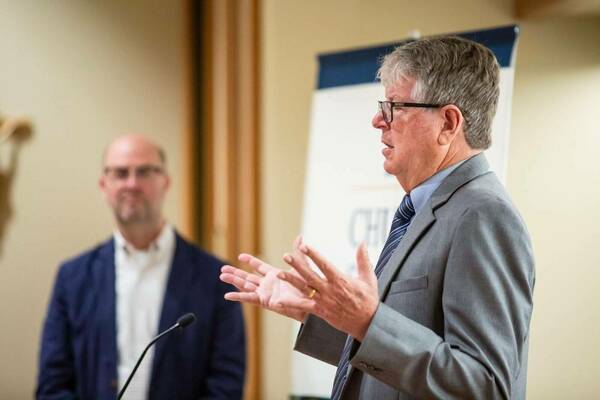
Smith drew on historical thinkers like John Murray and John Rawls to discuss two approaches to public engagement with truth. He argued that avoiding discussions about fundamental truths, in an effort to maintain civility, can lead to a fragmented society. He warned that when people refrain from engaging in meaningful debates about truth, they risk overlooking what fundamentally connects them as human beings. On the other hand, dialoguing with others is a “manifestation of respect for your neighbors’ beliefs.”
Throughout his lecture, Smith advocated for a return to a robust understanding of truth, one that respects individual beliefs while also affirming the necessity of communal dialogue. He posited that “the desire to live in accordance with what we believe to be true is not a preference,” but a defining aspect of humanity, essential for achieving genuine respect and understanding among individuals.
The Rice-Hasson Distinguished Lecture Series continues to provide a vital platform for these important conversations at Notre Dame, fostering a culture of intellectual and moral inquiry.
A recording of Smith’s lecture is available below:
Originally published by at law.nd.edu on November 11, 2024.